
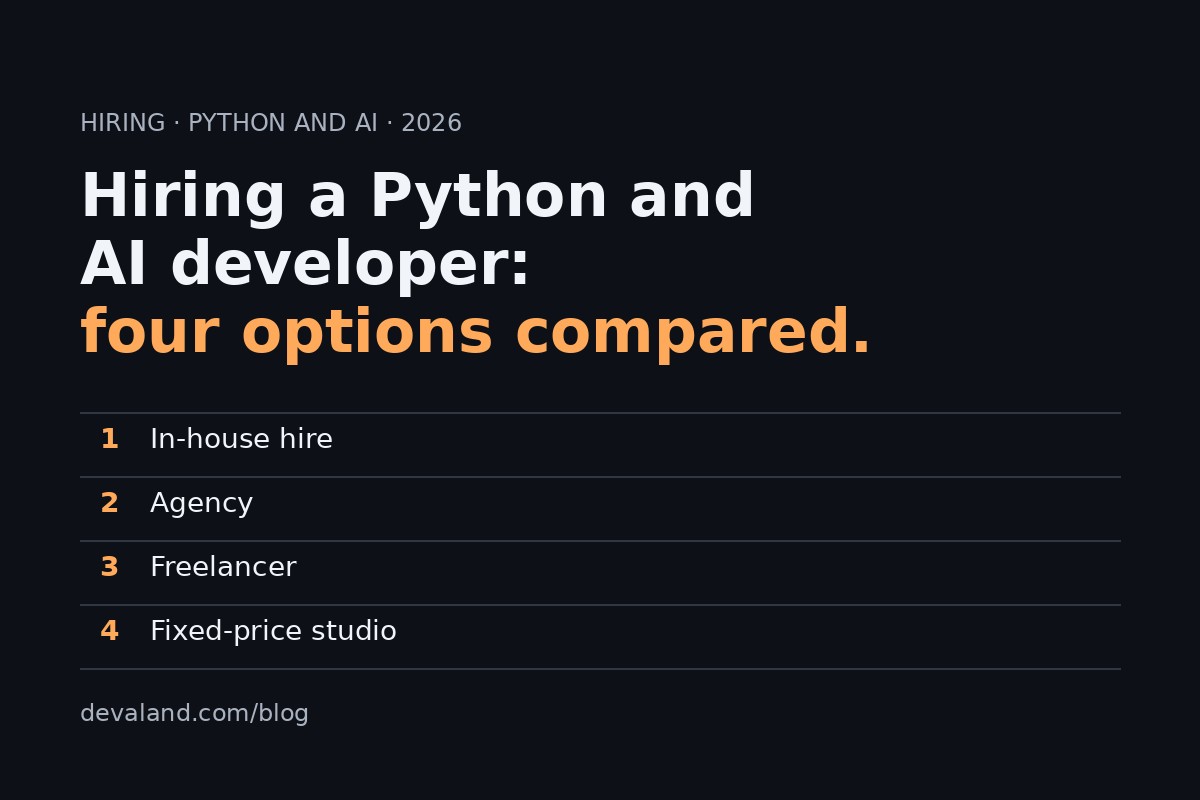
Short answer: there is no single best way to hire a Python and AI developer, because the four usual routes trade off different things. An in-house hire gives you continuity and costs the most time to start. An agency gives you a team and adds layers between you and the person writing the code. A freelancer is quick to start and concentrates the risk in one person. A fixed-price studio gives you a defined deliverable and a known number, and works best when the work can be scoped. This guide compares them by mechanism, so you can match the route to your situation instead of to a sales page.
Key facts:
- The four options differ on cost structure, speed to start, who owns the code, and what happens if the person leaves.
- A good Python and AI hire is judged on evidence: a working system on your own data, not a list of tools.
- Whatever the route, the code should live in a repository you control from the first commit.
- Ask for the scope, the price and the acceptance test in writing before work starts.
- This article describes mechanisms, not market prices. Rates vary widely, so get quotes for your own scope.
What you are actually buying
"A Python and AI developer" can mean very different work: a retrieval system over your documents, an assistant that answers from your data and cites its sources, a document-extraction pipeline, an automation that connects the tools you already use, or all four. The route you choose matters less than whether the person can show a system of that kind working, with tests, cost limits and a way to see when it fails.
Before comparing options, write down three things. What the system must do, in one paragraph. What data it will touch, and whether that data may leave your infrastructure. And how you will know it works, as a test you can run yourself. Every option below is easier to evaluate once you have those three answers.
The four options compared
| In-house hire | Agency | Freelancer | Fixed-price studio | |
|---|---|---|---|---|
| How you pay | Salary plus employer costs, whether or not there is work that week | Usually a rate per person or a project fee that includes the agency's overhead | A rate per hour or day, or a project fee | One agreed price for a defined scope |
| Speed to start | Slowest: search, interviews, notice period, onboarding | Often fast to staff, slower to scope | Often fast, depends on the person's availability | Quick once the scope is written down |
| Who writes the code | The person you hired | Depends on staffing: ask for names and seniority | The freelancer | One named engineer |
| Who owns the code | You, under the employment terms | Set by the contract: check it | Set by the contract: check it | Set by the contract: look for rights passing on final payment |
| If the person leaves | You lose their knowledge, unless it is written down | The agency can reassign, with a learning curve | The project can stall | The code and documentation are already yours |
| Best when | The work is continuous and central to your business | You need several skills at once on a large programme | You need a specific task done by someone you trust | You have a defined system to build and want to know the cost first |
| Main risk | A long search and a fixed cost before you know the fit | Layers between you and the engineering | One person is a single point of failure | The scope has to be clear enough to price |
In-house hire
How the cost works. You pay salary and the costs that come with employing someone, and you carry them in quiet months too. The cost is steady and predictable, and it does not shrink when the work does.
Speed to start. Searching, interviewing, negotiating and a notice period all come before the first commit. Teams often find that the underlying work is waiting for the hire to arrive.
Ownership and continuity. The code is yours under the employment terms. The risk is knowledge that lives in one head. If that person leaves, what is written down is what you keep.
Check before hiring. Ask for a small paid exercise on a real problem, not a puzzle. Ask how they handle tests, secrets, logging and cost control on AI features, because those decide whether a prototype survives in production.
Agency
How the cost works. An agency price includes its own overhead: account management, project management and the spread of skills it keeps on hand. That is a fair trade when you need many skills at once.
Speed to start. Staffing can be quick, but scoping with several people on your side and theirs can take longer than with one engineer.
Ownership and continuity. Read the contract for who owns the code and when. Ask who exactly writes it, how senior they are, and whether that person stays on your project.
Check before hiring. Ask to meet the engineers, not only the sales lead. Ask for a recent example of a similar system and what the client can verify about it.
Freelancer
How the cost works. Usually a rate per hour or per day, or a project fee. There is little overhead, which keeps the price close to the work.
Speed to start. Often the fastest route when you already know whom to ask. Availability is the limit.
Ownership and continuity. Everything depends on one person. Put the ownership of the code, handover notes and repository access in writing, and give the freelancer access to your repository, not the other way round.
Check before hiring. Ask what happens if they are unavailable for two weeks. Ask for references you can contact, and for a short paid first task.
Fixed-price studio
How the cost works. You agree a price for a defined deliverable before work starts. The price is known, and the work has an acceptance test. The trade-off is that the scope must be clear enough to price, and changes to the scope are agreed in writing.
Speed to start. Fast once the scope is on paper, because there is no search and no onboarding. A short paid pilot can show whether the approach works before you commit to a full build.
Ownership and continuity. Look for the code living in a repository in your account from the first commit, with full rights passing to you on final payment. Then you depend on nobody to run or change it.
Check before hiring. Ask what is in the scope and what is not, what the acceptance test is, and what the price covers if the first approach does not work.
Our own option, described plainly
Devaland is one example of the fixed-price route, so you can compare it with the others on the same points.
- Who you work with. One senior Python and AI engineer writes the code and is accountable for the result. It is not an agency and there are no account managers.
- How the contract works. B2B, invoiced by DEVALAND MARKETING S.R.L. There is no headcount, no exclusivity and no retainer, and nothing continues unless you ask for it.
- How the price works. A fixed price for a defined scope, agreed in writing before anything starts. There is no hourly meter on a project.
- How to start. A paid proof pilot, from $2,500 as published on the AI and Python builds page, with one clear deliverable on your real data. If you continue, the pilot fee is credited toward the full build.
- How we work. In writing and asynchronously. Intake is a short written form. If training is part of a project, it is written guides and recorded video, never live sessions.
- Who owns the code. It lives in a GitHub repository in your own account from the first commit. Full rights pass to you on final payment.
- Tax treatment. Prices are in US dollars and exclude VAT. Romanian clients have Romanian VAT added, EU businesses with a valid VAT number are normally handled under the reverse charge, and clients outside the EU pay no EU VAT. Your exact treatment is confirmed in writing before anything is signed.
This route is not right for everything. If your work is continuous and central to your product, an in-house engineer is likely the better fit. If you cannot yet describe what you want built, start with a short written scope before choosing any route, or read what a paid AI pilot looks like.
How to choose: a checklist
- Is the work defined or open-ended? Defined work suits a fixed price. Open-ended, continuous work suits a hire or an ongoing arrangement. See also hiring a fractional AI engineer.
- How soon does it have to exist? If a hire cannot start for months, weigh the cost of waiting against a pilot that starts sooner.
- Who must be able to maintain it? If your own team will run it, insist on the repository, tests and written handover from day one.
- Does the data have to stay private? Ask what reaches any outside AI provider, and get the boundary in writing.
- What happens if the person disappears? The answer should be "nothing breaks": code in your account, documentation, no single login only they hold.
- What does it cost to run, not only to build? Ask about per-run cost caps and usage metering for any AI feature.
- Can you test it yourself? Agree an acceptance test on your own data before work starts.
- Is everything in writing? Scope, price, ownership of the code, and what happens if the first approach does not work.
If you want a second opinion on a scope, the AI and Python builds page explains how a written intake works, and custom AI development for founders covers what to define first.
Frequently asked questions
Is it better to hire a Python and AI developer or use an agency? It depends on whether the work is continuous or defined. Continuous work that sits at the centre of your product usually favours a hire. A defined system, or a need for several skills at once, can favour an agency or a studio. Compare them on the same points: cost structure, who writes the code, who owns it and what happens if someone leaves.
What should a fixed-price AI project include? A written scope, an acceptance test you can run on your own data, a delivery time, the ownership of the code, and what is and is not covered if the first approach does not work. Without those, a fixed price is only a number.
Who owns the code when I hire a freelancer or a studio? That is set by the contract, so read it. The cleanest arrangement is a repository in your own account from the first commit, with full rights passing to you on final payment.
How do I start without a large commitment? With a small paid pilot: one deliverable, a fixed price, a short time, your real data and a result you can judge. Devaland's published pilot starts from $2,500 excluding VAT, and the fee is credited toward the full build if you continue.
Do I need a call to get started? Not with us. Intake is a short written form, and scope, price and delivery are confirmed in writing. You can also phone or message if you prefer to be reachable that way.