
Built from nothing for a used-car dealer in Castellon
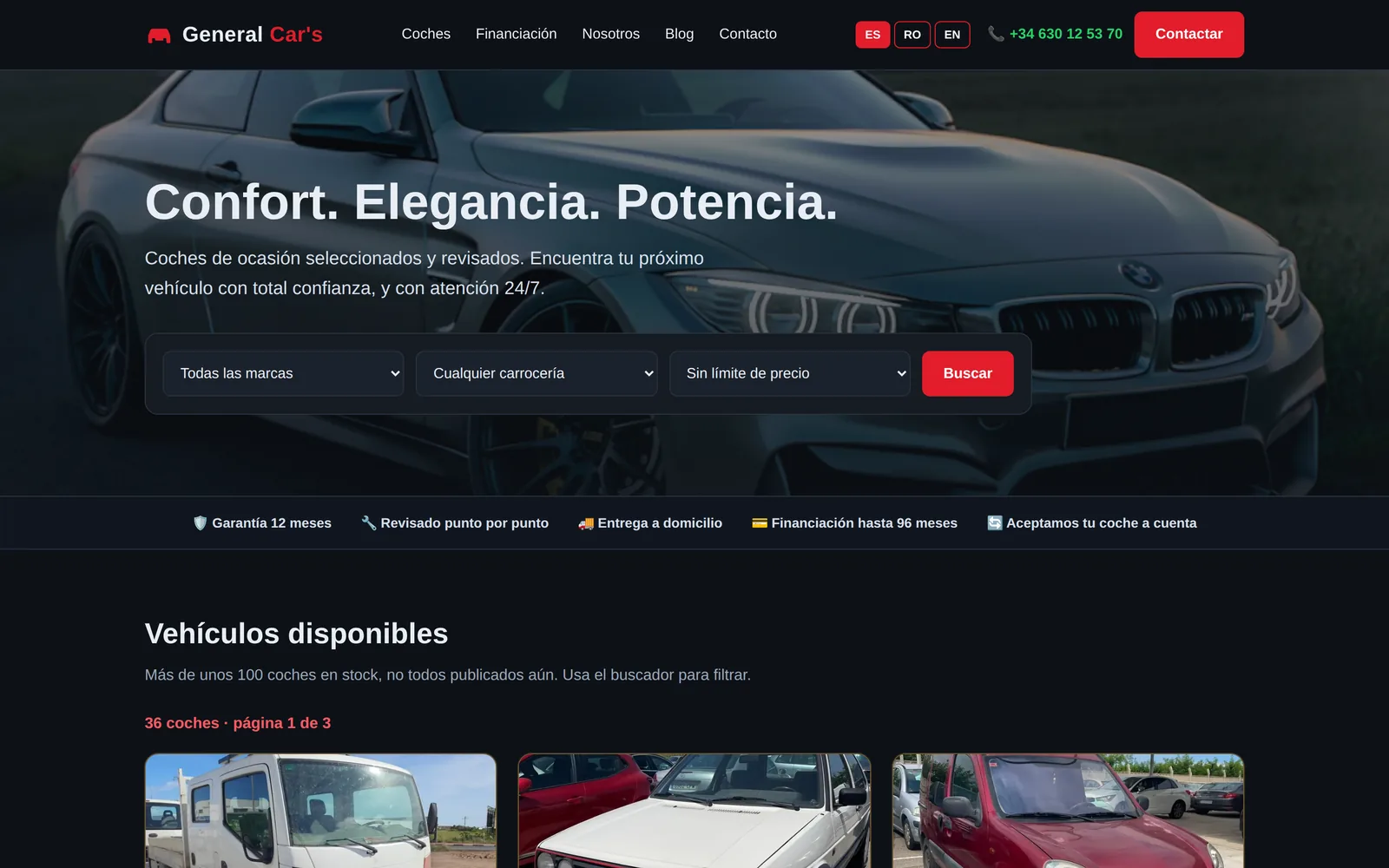
General Car's sells second-hand cars in Castello de la Plana, on the Valencian coast. Two employees, over a hundred vehicles in stock, and the owner works the service bays himself. When we started they had no website at all. Every piece of what follows, the trilingual site, the voice and text AI assistant, the self-serve inventory system, was designed and built here from a blank page, and the part that matters most: they run it themselves.
Where this started, which was nowhere
There was no website. Not a thin one, not an old one somebody else had built and abandoned. There was nothing to improve on, no theme to restyle, no pages to migrate. A dealership with over a hundred cars in the yard had no address of its own on the internet.
What existed instead was worse than nothing, because it was wrong. Their Google Business Profile still gave an address they had moved out of, a lot now occupied by a furniture retailer, so the buyers who did go looking were sent to a stranger's shop. Hours, services and description were stale or blank. The social accounts had gone quiet and were no longer posted to. Around fifteen of their roughly one hundred and fifty cars appeared online at all, scattered across classifieds accounts on somebody else's platform, which they did not control and could not point anyone to.
By the owners' own account the business was selling one or two cars a month. Not because the stock was bad or the prices were wrong, but because a buyer who cannot find you, cannot reach you after six in the evening, and lands at the wrong address when they try, simply buys elsewhere. That was the state of it when they came to us, and it is the reason the brief was never "make our site better."
The customer base is mixed, with a large Romanian-speaking community in the Castellon area alongside Spanish locals, so a single-language site was going to lose people before a conversation started. And the answer could not be "learn to run a website." Two employees, the owner working the service bays himself, and nobody with an hour a day to spend on listings. It had to work around the clock, in three languages, and stay current without a developer on call, which is what decided every design choice below.
What we built
One connected system, not a stack of disconnected tools, all running from a single source of truth the owners control themselves.
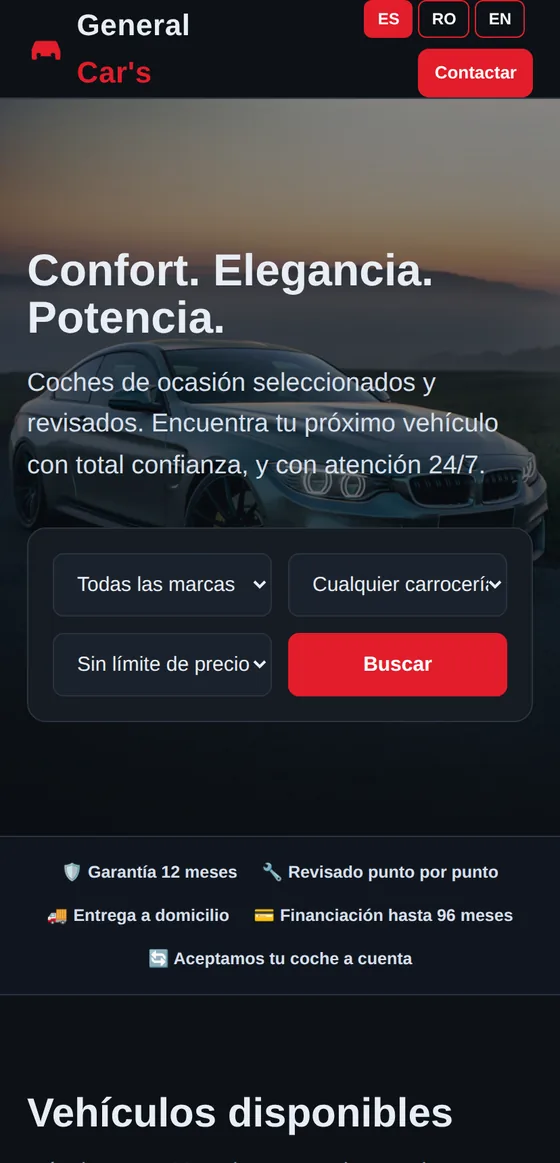
Trilingual website (ES / RO / EN)
A premium, fully responsive theme served in three languages, each with distinct URLs and correct hreflang so search engines index the right language for the right visitor. Spanish for the local market, Romanian for a large local customer base, English for everyone else.
"Carmen" AI assistant, voice and text
One shared brain answering by voice or text: multilingual, financing-aware, and able to recognise the owners by name. She captures the contact and fires an instant email plus a Telegram alert the moment someone is interested, so an enquiry cannot be missed. Built on Vapi with Anthropic and OpenAI language models.
Self-service inventory manager
The owners log in and add, edit, or mark a car as sold themselves, with drag-and-drop photos that are auto-compressed on upload. The website and the AI assistant both update within seconds, with no developer in the loop.
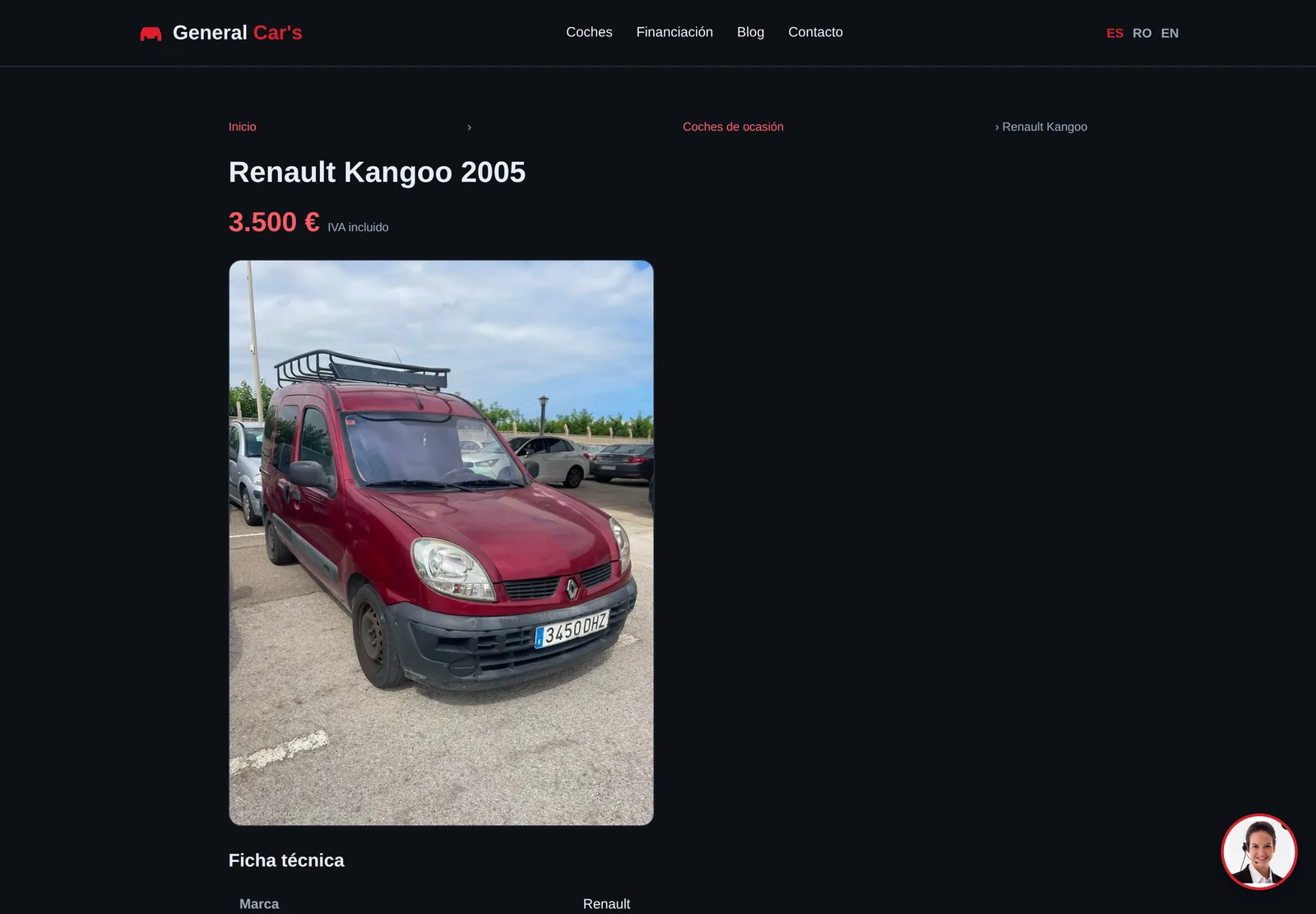
Per-car pages, generated automatically
Every vehicle published in the panel becomes three server-rendered landing pages, one per language, with the URL path localised, full hreflang between them, Vehicle structured data and a social-preview image. Nobody writes these by hand. As of 10 August 2026 that is 36 cars and 178 pages, and still growing.
Listings written from the photographs
The owners upload a car's photos and press one button. A vision model reads them and returns make, model, body style, fuel, colour, a year estimate and a sales description written separately in Spanish, Romanian and English. It only fills fields left empty, and it is built to refuse: no mileage, price, engine power or registration plate it cannot actually see in the photo. The only things typed by hand are price and kilometres.
Sold cars keep their address
A used car is one vehicle and never restocks, so the usual approach is to delete the page when it sells and throw away everything that listing earned in search. Here a sold car is archived instead of deleted: its URL stays alive and routes the visitor to what is currently in stock, so the searches keep landing, on a car that can still be bought.
Inventory syndication feeds
Coches.net XML, a Meta catalog feed, and a generic CSV export mean the whole stock can auto-publish to car marketplaces and social catalogs from the single source of truth the owners already maintain.
Local SEO / AEO engine
A 43-page blog across all three languages with FAQ schema, LocalBusiness and AutoDealer structured data (areas served plus languages), an llms.txt file written for answer engines, a robots.txt that names GPTBot, OAI-SearchBot, ChatGPT-User and ClaudeBot explicitly rather than leaving them to a wildcard, and IndexNow so new stock is submitted to Bing and the AI engines the moment it is published instead of waiting to be crawled. The Google Business Profile was reworked field by field in July: opening hours, services, description, website and WhatsApp.
One assistant, three languages, answering around the clock
Carmen answers by voice or by text from the same shared brain, in Spanish, Romanian, or English, whichever the visitor uses. She knows the financing options, recognises the owners by name, and the moment a buyer shows interest she captures the contact and sends an instant email plus a Telegram alert. A midnight enquiry becomes a saved contact instead of a closed tab, and the owner sees it the second it lands.
Stated honestly, because it is the more useful fact: she has not handled a real customer enquiry yet. The behaviour is tested and correct in all three languages, but at the traffic this site currently earns there is very little for her to answer. That is not a limit of the assistant, it is a limit of how much of the yard is online. Two thirds of the stock is still unlisted, and an unlisted car has no page, so it cannot be found and cannot start a conversation. The assistant is the part that is ready and waiting; the inventory is the part that is not.
The numbers that are actually verifiable
Every one of these pages was created here. There was no prior site to inherit them from, and none of this existed before the build. The honest measure of a self-serve system, though, is not whether it demos well. It is whether the client uses it when nobody is watching. The site launched on 16 July 2026 with two cars on it, added by us. Every one of the thirty-four since was published by the owner herself, and the pages generated and deployed on their own. Figures verified against the live site on 10 August 2026.
Re-measured on Google PageSpeed Insights on 10 August 2026, with the full live inventory loading: Performance 93 on mobile and 100 on desktop, Accessibility 100, SEO 100, Best Practices 96, and a Cumulative Layout Shift of 0 on both. Largest Contentful Paint 3.2s on a throttled mid-range phone, 0.7s on desktop.
The stack
What we found once we looked properly
Two weeks after launch we audited how the business actually appears in search, and the most interesting failure was not on the website at all.
Google's AI Overview, asked about the business by name, stated the old address as fact: a lot they had already left, now occupied by a furniture retailer. The Google Business Profile directly underneath it showed the correct address. So the AI summary was not reading the business profile. It was reading third-party directories that had never been updated, and no amount of fixing the profile could correct it.
That is a different problem from ordinary SEO and it needs a different fix: finding every stale citation and getting each one corrected at source. One of the largest Spanish motoring directories corrected their listing within a day of being asked.
A second thing worth stating plainly, because most agencies would quietly leave it out. The site is built to be quoted by AI assistants: the llms.txt file, the explicit crawler permissions, the structured data. It is not being quoted yet. Measured on 31 July 2026, assistants asked where to buy a used car in Castellon named the big national portals and local competitors, and never this dealership once. That measurement is written into the site's own robots.txt so nobody later mistakes the intent for the achievement.
What we are not claiming: there is no sales figure to report and we are not going to invent one. What is measurable, as of 10 August 2026: twenty-three visits from Spain through Google search in four weeks, from a standing start of zero a month earlier, and a Google rating up from 3.7 to nearly 3.9 after seven new five-star reviews. Set against that, roughly two thirds of the stock is still unlisted, and the rating needs about six more five-star reviews to clear 4.0, which is the threshold buyers look twice at. Anyone who tells you a new dealership site is already driving sales is guessing. We would rather show you the parts you can check.
Want a system like this for your business?
A fast multilingual website, an AI assistant that answers and captures leads around the clock, and the local SEO to get found, designed and built by the person who runs it. Send a short written brief and I will tell you honestly whether it is a fit. No sales calls.