
I have been setting scientific books and journal papers for more than twenty years. In that time the tools changed completely and the workflow barely moved. A manuscript still goes from acceptance to press through a chain of steps, and a surprising number of them are still done by a person retyping something that already exists in machine-readable form somewhere else.
This is not a complaint about publishers. Most of these steps stayed manual for a rational reason: the volume at any single mid-size house is too low to justify building the tool, and the vendors who do have the volume sell it back at a price only the largest five can pay. So the work sits in the middle, too big to ignore and too small to fix.
Having spent two decades on the production side and the last few building software that reads documents, here is my honest list. What should not still be manual, what genuinely should stay human, and why the difference matters more than the automation.
Reference handling
This is the single biggest sink I have seen, and the most mechanical.
An author submits a bibliography in whatever style their last journal used, or in none. Someone converts it to house style: author order, initials, punctuation between fields, italicisation, page range format, how many authors before "et al", where the year sits. Then someone checks that each reference actually exists, that the DOI resolves, that the page range is real, that the year matches.
Every one of those is a rule. The rules are written down, in the house style guide. The conversion is deterministic and the checking is an API call. There is no judgement in reformatting a comma.
Author corrections
Proofs go out. They come back as PDF annotations, or scanned markup on paper, or an email that says "page 47, line 12, delete the second comma". Someone reads each correction and retypes it into the source.
This is the step that surprises people outside publishing. It is not rare and it is not small. A single book can carry several hundred corrections across two proof rounds, and each one is a manual edit that can itself introduce an error. The correction round exists to remove mistakes and it is one of the likeliest places to add one.
Extracting structured corrections from annotated proofs is now genuinely tractable. Applying them automatically is not, and should not be, but the transcription step in the middle is pure mechanical loss.
House style conformance
Spelling variant. Heading capitalisation. Units and their spacing. Abbreviations expanded on first use. Serial comma or not. Number ranges. How a genus is set on second mention.
A house style guide is a specification. It is just a specification written as a sixty-page PDF for humans, with the difficult half living in a senior desk editor's head and never written down at all. That undocumented half is exactly the part that gets applied inconsistently between one compositor and the next, and it is the part a new freelancer takes two books to learn.
Checking conformance is a rules engine and always was. Deciding what the rule should be is not, and never will be.
Metadata and deposit
Title, authors, affiliations, ORCIDs, abstract, keywords, funding statements, licence. All of it is already in the manuscript. Then it gets retyped into a deposit form or an XML template so a record can be registered.
The information exists in a structured document and is re-entered by hand into another structured document. That is the definition of a step that should not be manual.
Figures, permissions and queries
Which figures are reproduced from elsewhere, who granted permission, whether the credit line is present and correctly worded, whether the resolution is adequate for print. Usually a spreadsheet, usually maintained by hand, usually the thing that holds up a book at the last moment.
Queries have the same shape. The compositor flags things for the author, and that list lives in a document alongside the proofs, tracked manually, with no reliable link between a query and whether the answer ever got applied.
What should stay human, and I would say this to any publisher
I want to be exact here, because the credibility of everything above depends on it.
Copyediting judgement. Deciding whether a sentence says what the author meant is not a rules problem. It requires knowing the field well enough to spot when the words are technically fine and the meaning is wrong.
Mathematical composition. Where to break a long equation, whether something belongs inline or displayed, how to align a multi-line derivation so the structure of the argument is visible. This is typography as explanation and it is a craft.
Float placement. A figure has to sit near the text that refers to it, without orphaning a heading, without leaving a half-empty page, without pushing a table across a spread. Every solution is a compromise and choosing between compromises is judgement.
Knowing that something is a query. The genuinely skilled part of the job is noticing that a sentence is ambiguous when it reads perfectly well. You cannot write a rule for the thing whose defining feature is that it looks fine.
The pattern underneath
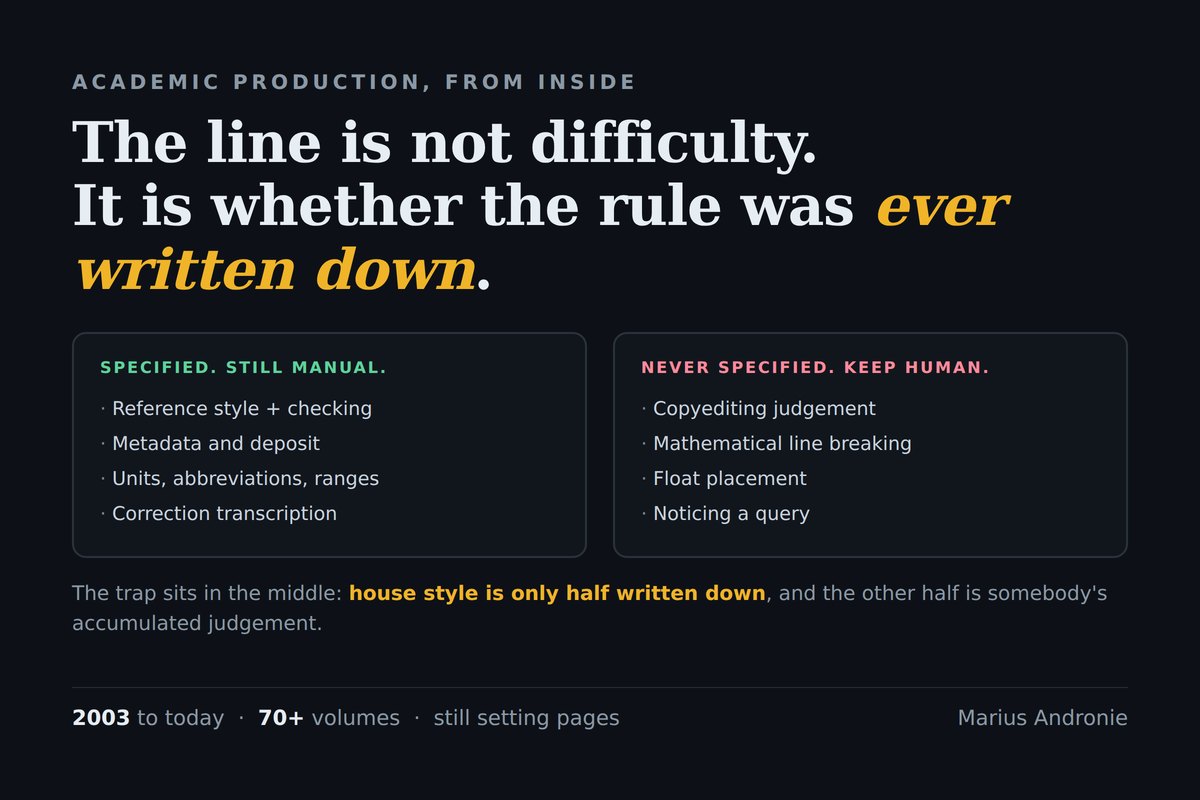
Look at both lists and the division is not difficulty. It is whether the rule was ever written down.
Reference style, metadata, unit spacing: all specified, all documented, all still done by hand. Float placement, ambiguity detection, mathematical line breaking: never specified, because they resist specification, and correctly still human.
The trap in the middle is house style, which is partly written down. The documented half is automatable today. The undocumented half is somebody's accumulated judgement, and the honest first step there is not automation. It is writing the rule down, at which point you usually discover that two people at the same publisher have been applying it differently for years.
That is the same thing I run into everywhere else I work. The reason a process resists automation is rarely that it is hard. It is that nobody ever had to write down what they were doing, because they were the only one doing it.
Why I am writing this down
I still typeset. I also build production software that reads documents and refuses to state anything it cannot trace to a source. Those two halves of my week point at the same problem from opposite ends, and the overlap is unusually specific: the parts of scientific production that are mechanical, repetitive, rule-governed, and still consuming a person's afternoon.
If you run production at a publisher and you recognise your own week in the first half of this list, I would be interested to hear which step actually costs you the most. Not the vision, the thing somebody retypes every Tuesday. In my experience it is references or corrections, and I have been wrong about which often enough to want to ask rather than assume.