
Quick answer: before buying any system that uses AI, ask the supplier five things in writing: where a person decides, what that person sees at the moment of decision, what the system does when it does not know, what is logged, and how the service runs when the AI component is down. The answers tell you more than any accuracy figure.
One project, described by its supplier
In an interview published by start-up.ro on 25 September 2026, the chief executive of the Romanian security company Hyperfy described a contract signed that month with the National Bank of Romania, after a public tender launched in December 2025: 12 million lei excluding VAT, over 24 months, to bring the bank's security systems into one central platform. On top of that infrastructure comes video analysis with AI: events in the footage become alerts that can be investigated and searched later.
The part worth reading twice is how responsibility is divided. In his words, translated from Romanian:
"The premise we start from is that the AI assists the operator and does not replace them. The final decision on whether to act stays with the person in the monitoring centre, who has the full context of the situation. For critical infrastructure, we prefer an alert that an operator has to check to lowering the sensitivity of the system and missing a real incident."
These are the supplier's figures and words as published. We have not seen the contract and have not tested the system.
The same idea, from an infrastructure integrator
Five days later the same publication interviewed the general manager of SolvIT Networks, an IT infrastructure and security integrator working with banks, telecom operators and public administration. He put the general principle this way (our translation):
"The value will not lie in simple access to AI, which almost everyone will have, but in judgment: knowing where you must not let it decide alone, and how you protect yourself from the risks it brings."
And on responsibility: automation does not remove it, it concentrates it. If a system takes a decision, someone still has to understand the context, the risk and the consequences.
Five questions for any AI system you buy
They work for a chat assistant on a town hall website as well as for a monitoring centre, and they fit in a specification.
1. Where does a person decide? Ask for the exact list of steps where the system only proposes, and the steps, if any, where it acts by itself.
2. What does the person see at the moment of decision? An alert without context is noise. An answer without a source is an opinion. Require every answer to show the document, page or recording it comes from.
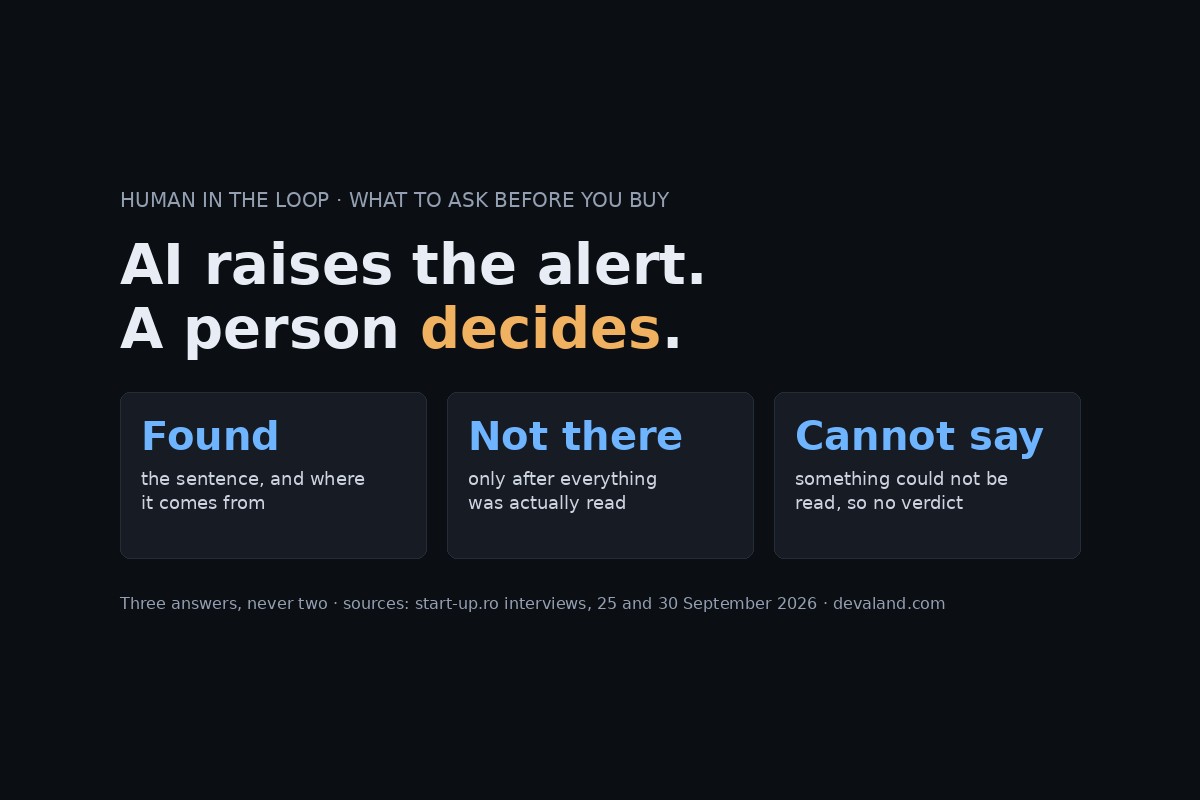
3. What does the system do when it does not know? A sound system has three answers, not two: found, not there, and could not check. A system that turns "I could not read it" into "it is not there" produces errors that look like answers.
4. What stays written down? Ask for a log of alerts and decisions, so an incident can be revisited and you can see who decided and on what basis.
5. What happens when the AI component is down? The service to the public, or the security of the building, must not depend on it. Ask for the description of how the work runs without it.
How we apply the rule
The assistants we build answer only from the client's own documents and point to their source, and what cannot be verified does not reach a person. We put the three-answer rule into a small open-source tool that reads PDFs on your own machine with a local model and names the page for everything it says: everypage on GitHub. We also measured what happens without that rule: when the page with the answer never reached them, several models computed a figure the document never states.
Sources
- start-up.ro, interview with the CEO of Hyperfy on the National Bank of Romania project, 25 September 2026
- start-up.ro, interview with Mihai Scemtovici, SolvIT Networks, 30 September 2026
Read on 2 October 2026. Quotations are our translations from Romanian. If you find a difference from the source, write to us and we will correct the article.