
What Is a CIM in M&A? What a Confidential Information Memorandum Contains, and What It Leaves Out
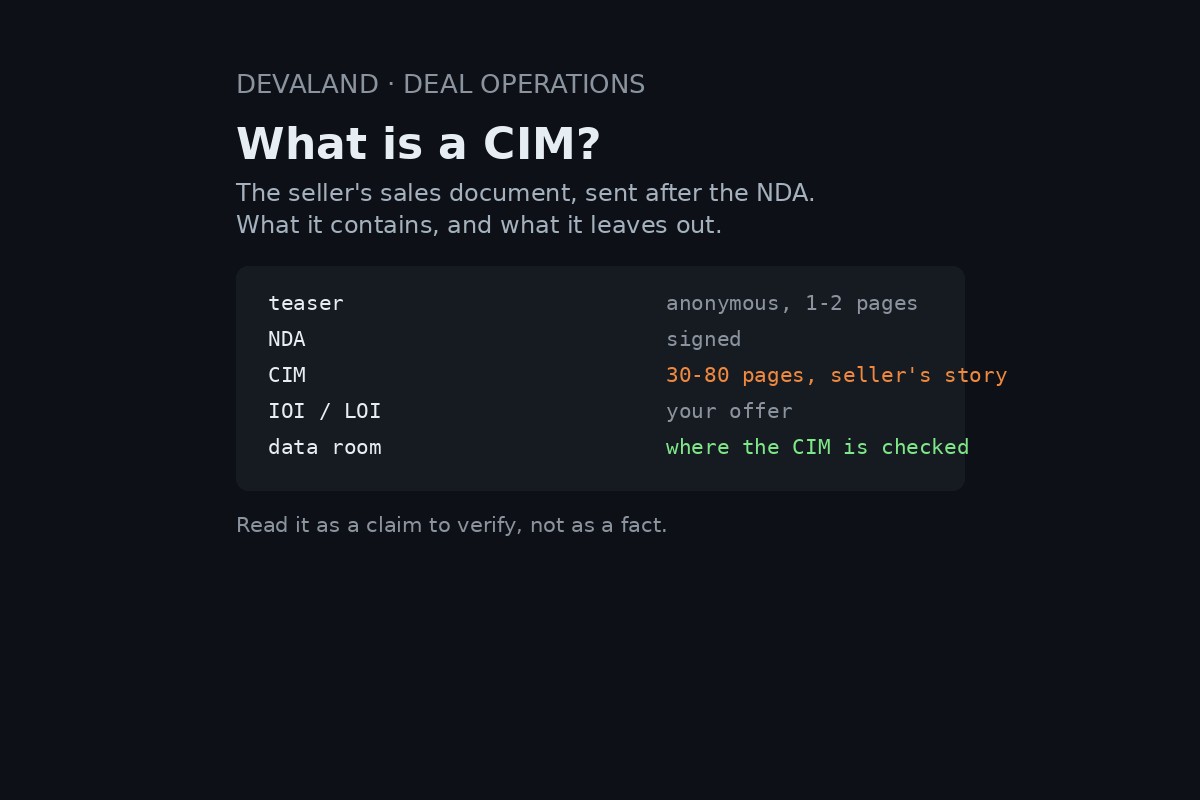
Short answer: CIM stands for Confidential Information Memorandum. It is the detailed document a seller's advisor (an investment banker, M&A advisor or business broker) sends to a prospective buyer after the buyer signs an NDA. It describes the business, its market, customers, operations and financials, and its job is to sell. It is the first real look at a company for sale, and it is written to make you bid, not to make you safe.
If you have just received your first one, this guide covers what a CIM is, where it sits in the sale process, what is normally inside, what is never inside, and the mistakes first-time readers make. For the "how do I read it" part, we keep a separate walkthrough: How to Analyze a CIM.
What does CIM stand for in M&A?
CIM is short for Confidential Information Memorandum. You will also hear it called the "book", the "deck", the "offering memorandum" or the "information memorandum" (IM). In practice these all point at the same thing: the long-form marketing document for a business that is for sale.
"Confidential" is not decoration. The document names the company, its customers and its numbers, which is why you only get it after signing a non-disclosure agreement. If the seller is selling quietly, even the company name is held back until the NDA is in place.
Where the CIM sits in the sale process
Most sell-side processes, whether run by a banker on a larger deal or a broker on a smaller one, follow roughly the same order. The names and the speed vary, but the sequence is familiar:
- ✓Teaser. A short, anonymous summary, often one page, sent widely to see who is interested. No company name, rounded numbers.
- ✓NDA. You sign a confidentiality agreement. This is what unlocks the name and the detail.
- ✓CIM. The full memorandum arrives. You read it and decide whether the business is worth more of your time and money.
- ✓Indication of Interest (IOI). A non-binding statement of how you see value, usually a range or a headline number plus a few conditions. Some processes skip it and go straight to an LOI.
- ✓Management meeting or call. The seller (and often the advisor) presents the business and you ask questions.
- ✓Letter of Intent (LOI). A more specific offer: price, structure, timing, exclusivity. Typically only a small group of buyers get this far.
- ✓Data room and confirmatory diligence. You get source documents and verify what the CIM claimed. This is where a Quality of Earnings review and your due diligence checklist do the real work.
The CIM is the decision point between "interesting" and "worth paying for diligence". Everything before it is cheap. Everything after it costs you time, advisers and usually legal fees.
Who writes the CIM, and how long is it?
The sell-side advisor writes it, working from information the owner and management supply. The advisor is paid, directly or through a success fee, to get the business sold at a good price. That does not make the CIM dishonest. It makes it an advocate's document: accurate in the facts it chooses to state, and selective in which facts it chooses.
Length varies a lot. A CIM for a larger company can run to many dozens of pages; a broker's memorandum for a small business is often shorter and simpler. As typical practice, expect somewhere in the range of 30 to 80 pages for a professionally prepared one, but there is no standard, and a short CIM is not automatically a bad sign. What matters is how much of it is checkable evidence and how much is narrative.
What a CIM typically contains
Section names differ, but most CIMs cover the same ground:
- ✓Executive summary or investment highlights. The pitch in miniature: why this business is attractive.
- ✓Company overview and history. What it does, when it started, locations, ownership.
- ✓Products and services. What it sells and how it makes money.
- ✓Customers and sales. Who buys, how they are acquired, often with a logo wall or high-level mix.
- ✓Market and competition. Industry size, growth story and where the company fits.
- ✓Operations. Facilities, suppliers, technology, processes.
- ✓Management and employees. Who runs it, org chart, headcount, sometimes how much the owner is involved.
- ✓Financial summary. Historical revenue, gross profit and EBITDA, usually with an "Adjusted EBITDA" and a list of add-backs, plus projections.
- ✓Growth opportunities. What a new owner could do with the business.
- ✓Transaction overview and process. Often a short note on timing, how to submit an IOI and who to contact.
The financial section is the part buyers spend the most time on, and the part most likely to contain claims that need to be tested rather than accepted.
What a CIM never contains
This is the part first-time readers underestimate. A CIM is built from what the seller wants you to see. Expect it to be thin or silent on:
- ✓Source documents. No bank statements, tax returns, contracts or general ledger. Those come in the data room, if at all.
- ✓A real customer-by-customer revenue table. You may get percentages for the top few, or only a statement that the base is "diversified".
- ✓The full story on why the owner is selling. You will get a reason. It will be a reasonable-sounding one.
- ✓Weak spots stated as weak spots. Declining margins, lost customers, key-person dependency and deferred spending tend to appear, if at all, as neutral facts or as "opportunities".
- ✓Verified earnings. Adjusted EBITDA in a CIM is the seller's number. It has not been through a buyer's accountant.
- ✓Legal and compliance exposure. Pending disputes, licence issues, permits and similar items usually surface later.
- ✓Anything the advisor decided could scare buyers off before the LOI. Not necessarily hidden forever, just not volunteered.
The right reaction is not suspicion of every line. It is to treat the CIM as a list of claims, and to notice which claims arrive with evidence and which arrive alone.
CIM vs teaser vs pitch deck vs data room
These four get mixed up, especially in search results. They are different documents for different audiences and stages.
| Teaser | CIM | Pitch deck | Data room | |
|---|---|---|---|---|
| Who writes it | Sell-side advisor | Sell-side advisor | Founder or company, often raising money | Seller and advisor assemble it |
| Who reads it | Many potential buyers | Buyers who signed an NDA | Investors | Serious buyers late in the process |
| Stage | First contact | After NDA, before IOI or LOI | Fundraising | After or around the LOI |
| Purpose | Spark interest | Make the full case for the sale | Raise capital | Let the buyer verify |
| Identifies the company | Usually not | Yes | Yes | Yes |
| Contains source evidence | No | Rarely, mostly summaries | Rarely | Yes, this is its point |
The line that causes the most confusion is "CIM deck". A CIM is sometimes laid out as a slide-style deck and sometimes as a prose document, but it is not a startup pitch deck. A pitch deck sells the future of a company to an investor. A CIM sells a whole business, with a history and financials, to a buyer who will own it.
Common mistakes when reading your first CIM
Reading it as fact. It is a sales document. Pull out every number and every claim and mark whether the CIM supports it with evidence or just states it.
Anchoring on Adjusted EBITDA. The headline number is the end of a bridge of add-backs chosen by the seller. Read the bridge before you read the total. Some add-backs are legitimate (owner pay above a market replacement salary, a genuine one-off cost). Others are recurring costs wearing a one-time label.
Believing the market section. A large industry figure says nothing about whether this business is good. Focus on the company's actual position: its customers, its margins, its competitors in its own geography or niche.
Skipping what is missing. The absences matter as much as the content. No customer breakdown, no churn data, no explanation of a dip in one year: write each one down. That list becomes your first request to the advisor.
Reading it once, quickly. First-time buyers often skim a CIM for the story and make an emotional call. Read it twice: once for the story, once with a pen to find what the story rests on.
Forgetting the process. Advisors run competitive timelines. The CIM often comes with an IOI deadline. Decide in advance what you need to see to submit one, so a deadline does not make the decision for you.
Treating it as the end of the work. The CIM earns an LOI at most. The facts come from the data room and from a QoE review. For the full reading method, see How to Analyze a CIM, and for how your buyer type shapes the process, see search fund vs independent sponsor.
A faster way to do the first read
Reading a CIM carefully takes hours, and a serious buyer may see many. Tools can help with the mechanical part: extracting figures, lining up the add-backs, flagging claims that have no support. If you are comparing options, we wrote an honest look at AI CIM analysis tools in 2026.
Deal OS is ours. It reads the CIM and returns a diligence brief in which every claim is cited to its source page, so you can click through and check it. It does not replace your judgment, your accountant or your lawyer; it shortens the time between receiving a CIM and knowing what to ask. Your first CIM is free: try it here. After that it is $99 per CIM, with plans from $249 per month (prices in USD, excluding VAT).
Frequently asked questions
What does CIM stand for in M&A? Confidential Information Memorandum. It is the detailed document a seller's advisor shares with a prospective buyer, after an NDA is signed, describing the business, its market, customers and financials. It is also called the book, the deck or the information memorandum.
What is the difference between a CIM and a teaser? A teaser is a short, anonymous summary sent widely to gauge interest before any NDA. The CIM comes afterwards, names the company and gives the full picture, including historical financials and projections. The teaser asks "are you interested?"; the CIM asks "will you bid?".
Who writes a CIM and who gets it? The sell-side advisor writes it, using information from the owner and management. It goes to prospective buyers who have signed an NDA. Because the advisor works for the seller, the CIM presents the business favourably, and its claims need to be verified later.
Can I trust the numbers in a CIM? Treat them as the seller's claims, not verified facts. Adjusted EBITDA in particular reflects add-backs the seller chose. You confirm the numbers in the data room and through a Quality of Earnings review before relying on them or putting them in an offer.
What comes after the CIM? Usually an Indication of Interest or directly a Letter of Intent, then a management meeting, then confirmatory due diligence in a data room. The CIM is the filter that decides whether a buyer spends money on that later work.
📚 Related Resources
Get the 45-Point Acquisition Diligence Checklist
The complete pre-close checklist search funds, independent sponsors, and micro-PE buyers use to verify a business before they sign, free, and yours in one click.
Get the free checklist →Already have a CIM in front of you? Run your first CIM free and read the full cited brief today. No card, no subscription, no sales call. Each further CIM is a one-time $99.